
Tax and Charitable Solicitation Filing Requirements for Nonprofits
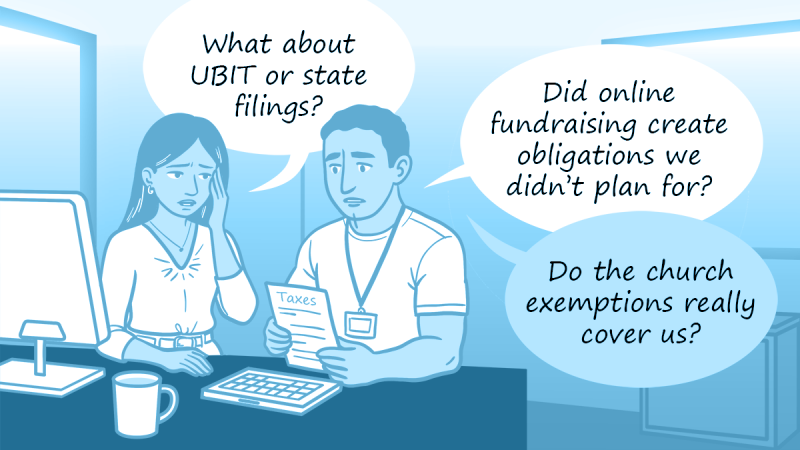
Tax season is approaching, and nonprofits have federal and state filing obligations to maintain their tax-exempt status and stay in good standing. First, the organization must have proper tax-exempt status in the first place. Just being a nonprofit under state law doesn't mean an organization is tax-exempt under federal law.
Nonprofit Formation and Status
Initially, a nonprofit must register with the state, typically the Attorney General's Office, filing its Articles of Incorporation. Then it must apply for tax-exempt status with the IRS, usually as a 501(c)(3) organization, typically by filing Form 1023 or Form 1023-EZ (for smaller organizations). There will then be periodic state reporting, such as annual registrations or financial disclosures.
Annual Filings
Once it is approved as a nonprofit, the organization will file an annual information tax return, usually Form 990, 990-EZ or 990-N, depending on the size of the organization. Private foundations usually file a Form 990-PF.
These are not income tax forms, but disclosure important information about the organization, including revenue and expenses, governance structure, program activities, and compensation of key employees. Form 990 filings are public records.
If an organization fails to file a required Form 990 for three consecutive years, the IRS automatically revokes its tax-exempt status. Reinstatement can be time-consuming and expensive.
The nonprofit could have unrelated business income, which is income from a trade or business that is not substantially related to the organization's exempt purpose. If this is the case, the organization may have to report the income and may owe unrelated business income tax (UBIT).
State filing requirements may include annual nonprofit or charity registration renewals, sales or use tax filings, or state employment filings.
Special Status for Churches
Churches are generally tax-exempt under Section 501(c)(3) without needing to apply for IRS recognition. In addition, they are not required to file any Form 990.
This exception applies to churches, integrated auxiliaries of churches, associations of churches, some church-related schools, and some ministries closely connected to a church.
Churches may still need to report UBIT and provide certain state filings. Churches may also be subject to some IRS rules, such as those forbidding private benefit.
Churches should still keep good financial records, minutes from the governing body, and good policies.
Taxes for the Employees and Contractors
If the nonprofit has employees, there are federal payroll tax filings, W-2s and W-3s, state payroll filings, workers' compensation, and unemployment tax compliance. Proper worker classification is very important, because it can create all kinds of fines and penalties to get it wrong, besides being unfair to the workers.
Nonprofits that have employees in more than one state must pay careful attention to tax issues in all the relevant states.
At the end of the year, it's important to be current with W-2s and W-3s for employees and 1099s for contractors. These must be sent both to the IRS and recipients. An electronic format (such as Quickbooks) is highly recommended for convenience and repeatability from year to year.
Charitable Solicitation Registration
If the nonprofit raises funds, and particularly if it does so online, it's very important to comply with charitable solicitation registration requirements. These are state law requirements that apply when a nonprofit asks for or receives donations from residents of that state.
Most states require nonprofits to register with their charity office or the Attorney General before solicitating donations. This could include donation requests on a website, email fundraising campaigns, direct mail appeals, social media fundraising, or grant applications. State laws will determine what organizations have to register, depending on where the nonprofit is located, where the donors are located, and how the fundraising occurs. Online fundraising is often the most complicated, because many states take the position that a website that asks for donations counts as solicitation.
There may be exemptions for religious organizations and churches, very small nonprofits, or educational institutions, but the exemptions vary by state.
Charitable solicitation registration is typically an annual process. States often request an application, IRS determination letters, the Articles of Incorporation and Bylaws, financial statements, and filing fees. The nonprofit will also have to stay in good standing with the state and the IRS. Penalties for failure to register can be fairly heavy.
Many states require specific language on solicitation materials, both online and in print, outlining the nonprofit's registration status and where financial information is accessible.
The IRS and some states expect the organization to provide receipts that specify whether goods or services were provided in exchange. Proper acknowledgement letters for donors are important.
Many states require disclosures and registration for outside fundraising firms.
Handling Filings
A nonprofit may choose to handle the filings itself or may want to work with a CPA or tax attorney to prepare filings. In addition, a nonprofit may wish to get professional help in registering for charitable solicitations, particularly in multiple states.
Because of the generality of the information on this site, it may not apply to a given place, time, or set of facts. It is not intended to be legal advice, and should not be acted upon without specific legal advice based on particular situations